
What Is Academic Freedom?
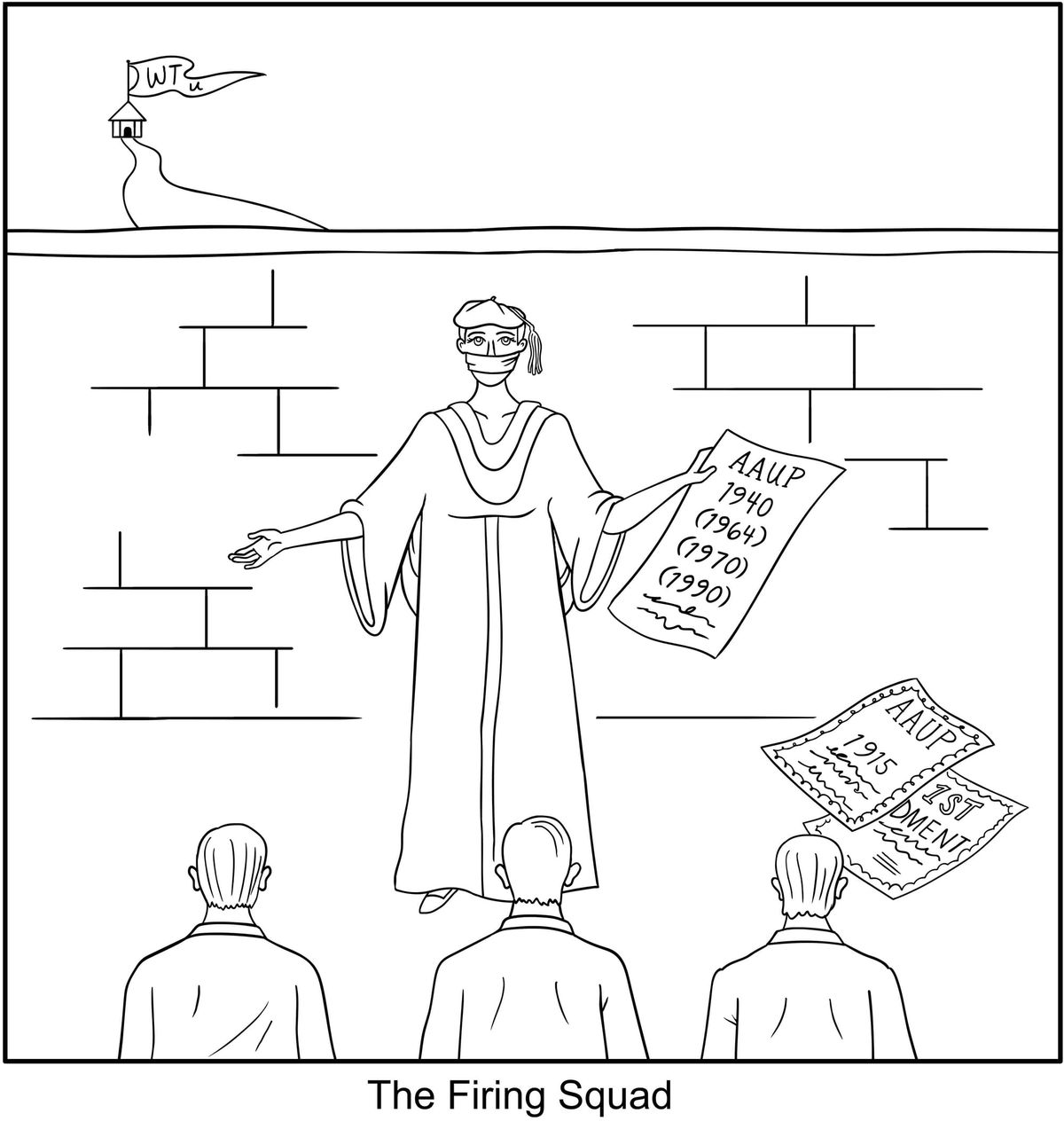
Sometimes it is good to have a break and come to a familiar subject with fresh eyes. Although I intended to write about tenure for this post, the history of which I know well and a matter on which I have given much thought, in the process of revisiting the literature I changed my mind. Academic freedom is the prior premise on which arguments for or against tenure rests, so we should start there.
And while some general retelling of the history of academic freedom is helpful, the real object is something much more philosophical and abstract: defining what we mean by academic freedom. This is a more difficult challenge than it sounds, as academic freedom can seem like nothing so much as an ongoing struggle for clarity. A good yardstick by which to indicate this is Socrates: In the 4th century BC he had to defend himself against the rich and politically powerful’s charges that he corrupted youth and was an immoral atheist because he questioned belief in the favored gods of the pantheon. In 2026, Socrates is, shockingly (in the form of Plato’s Dialogues), being banned from curricula for similar reasons.
Socrates was condemned for being “curious” and for conducting research into matters of the world and teaching about them, for the sins of having an interrogating mind and for being a teacher: helping others interrogate the world. In the US today one can be fired, perhaps one’s livelihood destroyed, on the basis of an utterance: for simply saying something with which moneyed or political interests (both within and outside the academy) do not agree, or that threatens their interests.
The history and trajectory of academic freedom is a long one. For our purposes, we’ll limit our review to the United States, including the major milestones, cases, and policies that have shaped our understanding of academic freedom here; we’ll postpone our discussion of academic freedom’s not-always-clear connection to tenure, which itself is now, and has been for many decades, on shaky ground. We’ll also limit it as it applies to faculty (the German concept called Lehrfreiheit) as opposed to students (Lernfreiheit) except for a few observations at the end. From this review, I offer the following conclusions:
- Academic freedom is an idea in practice; in trying to find an analogy for both its conception and its struggles, the one I keep returning to is democracy. This places academic freedom in the realm of governance as well as fights against tyranny.
- Academic freedom is a characteristic of universities—defining of the university and its separateness from other institutions (business, government), and without which its claims to being a university would crumble. It is the essential manner in which the public trust, and the good of the public, is promulgated, as distinguished from the fiduciary duties of trustees to the institution itself. In this sense, academic freedom is public-serving, and to serve the public it cannot be subject to the whims of public opinion.
- Academic freedom in the classroom for individual professors, as memorialized in accepted policy, is best described as a duty, even as the job or essence of the job of being a professor; it is not a right in law (although there is some law to support it); certainly, tenure is not a right.
- Academic freedom is the freedom for someone competently trained in the subject to fully teach and explore with students all aspects and perspectives on that subject that have been studied, developed, and tested by them and others competent in the subject, regardless of method used, without privileging a particular. This embodies the concepts of competence and neutrality—both of which have nuances as discussed further herein.
- There is broad agreement among liberal and conservative scholars about the imperative of academic agreement, with deviations centered mainly around neutrality questions in relation to student political activity and the duty of faculty to full and fair presentation of subject matter in teaching.
- Support for academic freedom has waxed (acceptance, even embrace) and waned (attack, refusal), but challenges throughout come from consistent sources: religion, political ideology, and protection of economic interests, increasingly merging together. Throughout the 20th century, the pattern of support and challenge went hand in hand with nationalist and antidemocratic forces, often overtly anti-labor and class-protectionist, at the extremes accompanied by bullying and intimidation tactics. In the 21st century we are seeing a return to overt religious claims, mixed with political ideology, that have not been a major part of the academic freedom struggle since the 19th century, and that are now magnified by social media and disinformation. We also see tremendous institutional conflict of interest related to the protection of academic freedom, with institutions more beholden to, and often more concerned with, outside interests than upholding academic norms.
- Individual professors may exercise their free speech rights as citizens with appropriate discretion and respect as supported by “reason and reasoned persuasion” (This is a large topic of its own, beyond the scope of concern with academic freedom’s implementation in teaching and research).
- Multiple sources suggest that stronger organization and pushback, particularly support from presidents, could have avoided some rulings against academic freedom. Elitism and complacency from tenured faculty may have weakened academic freedom for all now that the vast majority of faculty work off the tenure track.
In my next posts, we’ll look more closely at tenure—which I believe has become conflated or over-associated with academic freedom—and at questions of how, and whether, academic freedom can be truly protected.
The Birth and Formalization of Academic Freedom in the United States1
It is difficult to envision now, but for nearly 200 years, some of today’s leading universities were small, poor, and the few teachers were not yet considered professionals. As late as 1817, Princeton received only $1500 from its income-bearing assets (its net assets were $38.3 billion as of June); in 1830, Yale’s revenue from all sources was less than $20,000 (expected revenue this year is $6.37 billion, with an endowment of $41 billion). Until the mid and even late 1800s, most colleges were primarily denominational, and religious belief was the strongest threat to academic freedom; everything, including hiring and firing, was evaluated against “moral” implications and biblical teachings. As boards transitioned to non-clerical, filled with men with large economic interests, they became more generally authoritarian, highly sectarian, intrusive and often tyrannical. Founder-donors in particular were extremely powerful and attracted more businesspeople, as well as attorneys, to boards as a status symbol. Many of these trustee-donors, most notably Jane Stanford, behaved as if they “owned” the university (there is considerable anecdotal evidence that this is still the case), demanding complete control or control over specific aspects of university activity and firing people whose views were in opposition to theirs. Threats shifted from religion to the social sciences; professors were “purged” for economic, political, and social views such as supporting free trade, paper money, silver vs gold, anti-monopoly or anti-imperialist views, virtually anything that appeared to support labor. Doctrinal morality gave way to the notions of objectivity and experimentation (which implied a level of tolerance and room for error) and to pure pragmatism.
During the same period of a change, a combination of factors brought more power to faculty. One was internal: student behavior (which was out of control) and curriculum, previously under the authority of trustees, was passed onto faculty in hopes that they would have more success. Another was external: the rise of science, particularly in the form of two influences: Darwinism and exposure to the German university (Humboldtian) system, where professors had considerable autonomy (although under a very different, more conducive governance structure) and scientific and lab work were a dominant. One leading scholar of academic freedom claims academic freedom would not exist “without the canons of evolutionary science” (Metzger 1955, 89). It was indeed cases around the right to teach evolution, combined with the rise of scientific research as both the new value system and an attractive source of prestige and growth to trustees, that by the early 20th century came together to spur and ultimately support the movement to codify academic freedom. Its timing was also aided by the start of World War I and the first true demand by government and business for help from specialized faculty—somewhat convenienced by having a former Princeton university president, Woodrow Wilson, as the president of the United States.
In 1915, a new group led by Arthur Lovejoy and John Dewey called the American Association of University Professors met the moment by publishing the General Report of the Committee on Academic Freedom and Academic Tenure. It was developed and signed by 13 well-known, one might say elite, professors, eight of whom had worked under the German system and brought its ideals home to America; several of whom had been targets of past violations of their academic freedom; and, not surprisingly, most of whom were social scientists whose fields were vulnerable to challenge on political, economic, or social grounds.
The report laid out the purposes of the university . . .
The importance of academic freedom is most clearly perceived in the light of the purposes for which universities exist. These are three in number: A. To promote inquiry and advance the sum of human knowledge. B. To provide general instruction to the students. C. To develop experts for various branches of the public service.
. . . and argued why academic freedom was essential to fulfill these purposes, placing particular emphasis on academic freedom as a kind of bulwark against the tyranny of public opinion
This brings us to the most serious difficulty of this problem; namely, the dangers connected with the existence in a democracy of an overwhelming and concentrated public opinion. The tendency of modern democracy is for men to think alike, to feel alike, and to speak alike. Any departure from the conventional standards is apt to be regarded with suspicion. Public opinion is at once the chief safeguard of a democracy, and the chief menace to the real liberty of the individual. It almost seems as if the danger of despotism cannot be wholly averted under any form of government. In a political autocracy there is no effective public opinion, and all are subject to the tyranny of the ruler; in a democracy there is political freedom, but there is likely to be a tyranny of public opinion.
An inviolable refuge from such tyranny should be found in the university. It should be an intellectual experiment station, where new ideas may germinate and where their fruit, though still distasteful to the community as a whole, may be allowed to ripen until finally, perchance, it may become a part of the accepted intellectual food of the nation or of the world. Not less is it a distinctive duty of the university to be the conservator of all genuine elements of value in the past thought and life of mankind which are not in the fashion of the moment.
The report also elaborated the limits of academic freedom—the responsibilities that came with the rights—and laid out practical provisions for carrying it out, including the framework for tenure. Succinctly, these rights and their intentions were:
- required competence in subject matter and silence on matters on which one was not qualified;
- neutrality in the classroom on controversial issues while laying out all ideas, facets, and sides, aimed at providing the opposite of indoctrination;
- commitment to empiricism.
Given that up to this point the right of trustees to fire at will had been upheld in numerous cases, the report was, after an initial period of pushback, well-received if not widely adopted. But from the start the AAUP has consistently issued “interpretations,” consistent with the notion that policy must be reinforced and clarified in light of changing environmental conditions, and also with feedback. Hard-won support from the Association of American Colleges led to a conference with numerous other major college and university organizations, including the Association of Governing Boards, the Association of Land Grant Colleges, and the Association of American Universities.
This period of 25 years of work led to publication in 1940 of a revised statement, more compact, concise, vetted, and oriented to adoption of policy and procedure than the 1915 report. The “1940 Statement of Principles on Academic Freedom and Tenure” has long stood as the accepted statement on academic freedom, and has been endorsed (together with its 1970 updates) and otherwise incorporated into institutional policy (e.g., faculty handbooks) by more than 100 higher education associations and institutions. It reinforced the principles of academic freedom, explicitly laying out limitations as well as rights, including for extramural utterances as a citizen; and devoted nearly half to strengthening tenure and laying out due process for termination that would directly involve faculty, not just trustees; it called tenure “a means to certain ends” and a way to make the profession attractive by offering “a sufficient degree of economic security.” The 1940 Statement embodies the most accepted understanding of academic freedom and is worth the short read: see Library for a pdf of the full statement).
With the 1940 Statement the AAUP achieved a remarkable and ultimately near-universal level of acceptance that academic freedom was necessary to the university functions of teaching and research, which in turn was necessary to serve the common good. But it has required constant monitoring and enforcement, both through AAUP’s Committee A and the courts, with mixed success, and challenges to academic freedom are once again on the rise, including on the basis of something most people thought had been put to rest: religion—this time barely distinguishable from political ideology.
Below is a very brief status of where the law stands on academic freedom and due process for faculty, followed by a summary of renewed threats to academic freedom.
The United States Supreme Court and Academic Freedom
Most cases of academic freedom are internal, and those that reach the courts do not all reach the Supreme Court. Nevertheless, there is a long and rather squishy history of academic freedom and tenure in the highest court, one providing little clear legal guidance on which to rely. Most cases have dealt with the First Amendment, particularly those related to utterances made and activity conducted outside the classroom, and to a less extent the Fifth and Fourteenth Amendments, dealing with due process issues in hiring and termination cases and freedom of association.
Scholars have noted the tentativeness and hedging of the Supreme Court in affirming the academic freedom of professors as a matter of law in the Constitution. Perhaps the issues feel too close to home, or too difficult to square with the idea of intruding upon educational affairs and the private prerogatives of boards; in any case, the legal reasoning in some important cases has been viewed as anywhere from biased to intuitive to normative to inconsistent. It can feel as if there is very little, if any, settled law, including on whether academic freedom is a First Amendment right.
Notwithstanding, there are a handful of cases that stand out as important since the 1915 statement, or what we might call the modern era of academic freedom. Some early cases concerned public schools, but apply to higher education. Discussion is beyond our scope here, but for those interested, the following cases are worth looking up as examples of inching academic freedom toward consideration as a Constitutional right. They are only a few of the many cases showing how political and threatening an issue that seems so benign—the academic freedom of teachers—is. Because recent cases related to academic freedom—many of them complex due to their multipronged or triangular issues (e.g., withdrawal of science funding due to alleged Title VI violations)—are in process, they are not discussed here.2
Meyer vs Nebraska (262 Us 390, 1923). Prohibits the government from exacting any conditions (of employment, curriculum, etc) that are not Constitutional—i.e., the government cannot exploit its leverage over goods or positions it happens to control by setting conditions that are in fact unconstitutional (an “unconstitutional condition”). This case was about a state law, generally viewed as politically motivated, forbidding the teaching of a language other than English to students before grade 8. It used a due process rather than a First Amendment approach.
Adler v. Board of Education (342 US 485,1952). Adler involved a challenge to New York’s Feinberg Law calling for investigation of the political affiliations of schoolteachers. This was loyalty-oath era (many 20th century cases have been about freedom of association). Adler is the case that put the term “academic freedom” into the lexicon of First Amendment law through the dissent (the challenge lost) of justice William O. Doughlas: “a system of spying and surveillance. . . cannot go hand in hand with academic freedom.” It is also the root of claims that political litmus tests and government intrusion cast a “pall” over the classroom. (Adler, like numerous other cases supporting loyalty oaths in the 1950s and 1960s, was later overturned by Keyishian, below).
Sweezy v New Hampshire (354 US 234, 1957). This McCarthy-era case is notable for being explicitly about a professor’s right to teach (as opposed to the many contemporaneous cases on a state’s right to set limits to association), and may feel particularly timely in that it sought testimony about the content of a professor’s lecture. Quoting Judge Frankfurther’s ringing defense of academic freedom:
“A university ceases to be true to its own nature if it becomes the tool of Church or State or any sectional interest. A university is characterized by the spirit of free inquiry, its ideal being the ideal of Socrates—to follow the argument where it leads ... It is the business of a university to provide that atmosphere which is most conducive to speculation, experiment and creation. It is an atmosphere in which there prevail the four essential freedoms of a university-to determine for itself on academic grounds who may teach, what may be taught, how it shall be taught, and who may be admitted to study." (emphasis added)
While the finding in the case was made on technical grounds, this defense against “inquisition by political authority” is what is remembered.
Keyishian v. Board of Regents (385 US 589, 1967). This is the case that centered academic freedom squarely into the First Amendment, and overturned the Feinberg Law. In Justice Brennan’s oft-quoted words about casting a pall of orthodoxy:
“Academic freedom ... is of transcendent value to all of us and not merely to the teachers concerned. That freedom is therefore a special concern of the First Amendment (emphasis added), which does not tolerate laws that cast a pall of orthodoxy over the classroom. . . . The classroom is peculiarly the marketplace of ideas. The Nation's future depends upon leaders trained through wide exposure to that robust exchange of ideas which discovers truth out of a multitude of tongues, [rather] than through any kind of authoritative selection.”
Epperson v. Arkansas (393 US 97, 1968). The famous Scopes case on evolution was never appealed to the Supreme Court, but Epperson revisited it when another state law forbidding the teaching of evolution was upheld and ultimately made its way to the Supreme Court. The case had previously failed on freedom of speech grounds, with the state finding the prohibition was within the state’s power to control public school curriculum, but the Supreme Court took a lesson from Meyer and chose the narrower justification of the Establishment Clause (my personal favorite part of the First Amendment, and one I wish was used more for all kinds of violations). Epperson is very interesting in terms of the variety of reasoning by the justices about state curricular control and freedom of speech. This case was not a higher education case, but is considered instructive for higher education in its own struggle for curricular control by professors who are (unlike judges or trustees), competent to determine what constitutes legitimate subject matter for instruction.
Garcetti v. Ceballos (547 US 410, 2006). Although also not a higher education case, this case brought a shock of warning to the by-then taken-for-granted notion that academic freedom for public university employees was protected by the First Amendment, even implying that Keyishian was questionable. In it Justice Kennedy, in a 5-4 opinion, laid out an “official duties” test that comprised seemingly everything but expression far-removed from employment, and could easily have been applied to virtually all forms of academic speech. Dissenters, notably Justice Souter, warned about this. Since then, Garcetti has been used in lower-court cases to uphold the dismissal of professors, but it has also been rejected in others, such as Adams v. Trustees of the Univ. of N.C.–Wilmington (2011, 4th Circuit) and Demers v. Austin (2014, 9th Circuit), citing Souter’s dissent reasoning.
The State of Academic Freedom
In 1930, Arthur Lovejoy, co-founder of the AAUP, provided this simple definition of academic freedom:
“Academic freedom is the freedom of a teacher or researcher in higher institutions of learning to investigate and discuss the problems of his science and to express his conclusions, whether through publication or the instructions of students, without interference from political or ecclesiastical authority, or from the administrative officials of the institution in which he is employed, unless his methods are found by qualified bodies of his own profession to be clearly incompetent or contrary to professional ethics.”3
As successful as the AAUP has been in upholding this seemingly common-sense view against periodic attacks, its scope and approach may no longer comprise the issues of the university in an era where state, corporate, and megadonor influence have taken near-strangulatory hold, and where the idea of the expert, another seemingly common-sense notion (that some people are more qualified in specific areas by virtue of relevant training and experience than others without it) is questioned or rejected to the extent that lack of qualification has become a virtue at the highest levels of society. Add to this higher education’s, even AAUP’s, own internal undermining of academic freedom through distraction by shiny things and marginal issues, academic freedom finds itself under a fundamental threat that far surpasses the usual cases of individual violations. An unfortunate outcome is that fear of retribution has led to self-censorship on many levels: in the classroom, in research choices, in governance, in public speech.
With the law such a soft and unreliable arbiter of academic freedom, and many external threats to academic freedom being structural (although, ever optimistic, not wholly beyond influence), it is useful to consider which, if any, of the many pressures on academic freedom are at least partly under university control. It is a short list, but of big items, many arguably having been created by universities themselves. Dare we hope that this means universities could actually strengthen academic freedom themselves?
1. Disciplinary Divides. This goes beyond the usual “silo” accusations to highlight the absence of shared support and investment in academic freedom that is partly a function of differences in primary purpose (teaching vs research), discipline and disciplinary methods, respect for and curiosity about each other, relative differences in power and prestige, and the general lack of solidarity bred by the fact that, for most faculty, their primary allegiance or identity is with groups or entities outside the university. Some disciplines (mathematics, for example) are quite isolated from threats to academic freedom; others may be highly vulnerable (e.g., the social sciences and humanities generally, even the fine arts).
2. Lernfreiheit. Often referred to as “academic freedom for students,” this is really students’ freedom to learn, which includes freedom to choose his course of study, to learn free of indoctrination, and to be taught by qualified professors. As with academic freedom for professors, it is not a license to do whatever one wants. It is not a license to dictate or narrow curriculum, acceptable readings, topics of discussion, or manner in which a subject is taught or discussed. It is similarly not a license to prevent others from learning, whether through intimidation or disruption; to record and post faculty lectures or to otherwise use or undermine the learning environment for political purposes.
In contrast to academic freedom for professors, academic freedom for students has received little scrutiny and few questions about what student obligations are in regard to this freedom to learn, resulting in growing threats to faculty’s own academic freedom. While crises often result in setting up some rules after the fact, student expectations for behavior in the classroom and on campus are vague or absent, and enforcement of rules, including of Honor Codes, is increasingly rare.
3. The Research Enterprise. While the share of university research spending that comes from federal grants declined from a postwar high in 1967 of 72% to 41.6% in 2021, the reliance of academic institutions on federal money for research can be much higher: 55% in 2021. Depending on research focus, an individual university’s reliance on federal money can be much higher, even constituting a large share of its total revenue. For example, in 2022-23, MIT received 48% of its revenue from the government prior to recent cuts. In the mid-60’s, during what Kerr dubbed “the federal grant university,” percentages of operating budgets were majority: for 1964, CalTech 83%, MIT 81%, Princeton 75%, Columbia nearly 50%. By 1970, 2/3-3/4 of all research money came from the federal government (Metzger et al 1969).
What does this have to do with academic freedom? Much. It invites outside control, with the word “invite” being salient because universities, and individual professors, have utterly failed to stipulate the conditions under which it would conduct external research in order to preserve its own freedom in the work as well as the public’s access to and trust in taxpayer-funded research (this now also applies to research conducted for business). Entire fields have become secret and results are unpublished or delayed, data controlled, and subjects for research are chosen not by the researcher but conceived by the funder, constraining not only academic freedom but also exploration of entire subjects or perspectives under national security or economic development justifications. (Metzger et al 1969, Reichert 2021; for an overview of research on conflicted science, see “Ethics of Innovation,” Robbins 2012, in Library). These impacts have recently been exacerbated by grant program rules and approval processes rewritten in ways to specifically curtail or narrow research on an ideological bases, in all disciplines.
It is not an accident that the ostensibly strongest part of the university (research in the so-called hard sciences) is being attacked in order to control the weakest; such research gets all the money. But it shows how inextricably linked, despite the sense that many sciences are completely separate from the traditional academic side, all parts of the university are, and, in becoming such a massive target, how powerfully important academic freedom is in the eyes of those who seek to destroy it. It raises the question of whether faculty in the sciences have a “right” to agree to conditions that violate the accepted norms and definitions of academic freedom and whether doing so is a harm rather than a benefit; it can appear that many scientists have rationalized away ethical and academic freedom considerations for the money and prestige of grants. It also calls into question the ethics of university governing bodies, whether state or private, that condone the effective control and sale of knowledge, and readily allow the repression of academic freedom in order to satisfy donors (even individual trustees) or the government. I would argue that neglect of the tenets of integrity and of clear adherence to the obligation side of academic freedom in the sciences have paved the way for the current tumult in the grant world.
4. Faculty composition. Only about a quarter of all faculty are tenure line, and adjuncts—"gig workers” who piece together courses to earn a living—make up about 40% of instructional faculty; they do not qualify for retirement and rarely for health benefits. On average, part-time faculty “full-time equivalent” earnings are unconscionably low: Kezar et al 2019 reported $22,400 for eight classes; a quarter of these faculty are on some sort of public assistance (Reichman, 2021). Perhaps 20% of non-tenure line faculty are full time faculty; they generally, although not always, make significantly less than their tenure-line peers, and do not have similar due process protections.
This is a problem of the university’s creation, and to a great extent of AAUP’s, and may be most of all a self-inflicted wound in the viability of academic freedom as well as the rationale for tenure. And it is closely related to the neglect of the academic core in favor of federally funded growth in science.
I'll discuss tenure, and how academic freedom might be re-secured, in upcoming posts. As a lover of definitions, I'll also wade into what a tighter definition of academic freedom's rights and obligations might look like.
_____
1 The discussion of academic freedom in this post is limited to academic freedom as it applies to faculty and not students, which is another discussion, and geared primarily to questions of academic freedom within the university. Both general histories and articles and forum discussions on particular issues and court cases in academic freedom contributed to this post, most notably the following: Hofstadter, R and Metzger, W.P., The Development of Academic Freedom in the United States 1955 (see particularly for pre-AAUP history and cases); Metzger, W., Academic Freedom in the Age of the University, 1967; Van Allstyne, William, “Academic Freedom and the First Amendment in the Supreme Court of the United States: An Unhurried Historical Review,” in Allstyne, William W., ed, Freedom and Tenure in the Academy 1993; Rabban, D.M., Academic Freedom: From Professional Norm to First Amendment Right, 2024; Earle, Valerie, ed., On Academic Freedom, 1971. For a concise contemporary overview of academic freedom, see Reichman, H. Understanding Academic Freedom 2021. See Library for full citations of these and additional works consulted for this post, as well as History of Education Quarterly for a series of useful articles published in 2018 under the label "Forum on Academic Freedom" across several volumes.
2Some of these cases seem to merge academic freedom and “unconstitutional conditions.” A case outside of higher education that has been cited on academic freedom in one of Harvard’s lawsuits, but has some substantive similarities to Meyer, is the recent unanimous National Rifle Association of America v. Vullo, 602 US 175 (2024), in which Justice Sotomayor stated that "[g]overnment officials cannot attempt to coerce private parties in order to punish or suppress views that the government disfavors."
3Encylopedia of the Social Sciences, 1930, I, p. 384. Quoted in Herberg, Will, “On the Meaning of Academic Freedom,” in Earle, Valerie, ed. Op cit.
__
Up Next:
- Thoughts on the Future of Tenure
- Remedies for What Ails Academic Freedom